

It’s easy to forget how much electricity hums behind the scenes of our digital lives: from data centers feeding AI algorithms to factories running 24/7, the modern economy is an electrified one. Few companies are as deeply embedded in this trend as Schneider Electric, a French powerhouse that has quietly built a global franchise in energy management and industrial automation. After digging into their latest results, I see a business that is both fundamentally strong and strategically well positioned for the long haul.
A quick snapshot
Schneider Electric describes itself as “the digital transformation of energy management and automation”. It operates two primary businesses:
Energy Management (about half of revenue), offering electrical distribution products, systems and services. In FY 2024 this division grew organically by 12 % and saw double‑digit demand from data centres and electrification projects .
Industrial Automation, providing hardware and software for factories and process industries. This unit contracted by about 4 % last year as customers delayed capex . Management noted, however, that discrete automation demand began recovering in 2025 .
Schneider also owns software businesses (AVEVA, ETAP and RIB), which are migrating to subscription models; annualized recurring revenue grew double‑digit in the first half of 2025 .
Record 2024 results
FY 2024 was a record year. Revenue rose to €38.15 billion, up 8.4 % organically . Adjusted EBITA jumped 14.2 % organically to €7.08 billion, lifting the margin to 18.6 % . Net income (group share) reached €4.27 billion, and the company generated €4.22 billion in free cash flow . Perhaps most impressively, Schneider was recognized as the world’s most sustainable company by Corporate Knights and posted a Sustainability Impact score of 7.55 versus its 7.40 target .
Why I like the stock
Structural tailwinds. Electrification of buildings, industry and transport is accelerating, and Schneider is a leader in electrical distribution and grid digitalization . Data‑centre demand continues to surge due to AI and cloud computing .
Software leverage. The shift toward subscription‑based software (e.g., AVEVA) should provide recurring revenue and higher margins over time .
Emerging‑market opportunity. The firm is taking full ownership of its India joint venture and reported double‑digit growth in North America, India and the Middle East in Q2 2025 .
Solid financials. Net debt fell to €8.15 billion and free‑cash‑flow conversion was 99 % . A progressive dividend policy lifted the payout to €3.90 per share , though the yield is modest (~1.5 %).
Valuation and target price
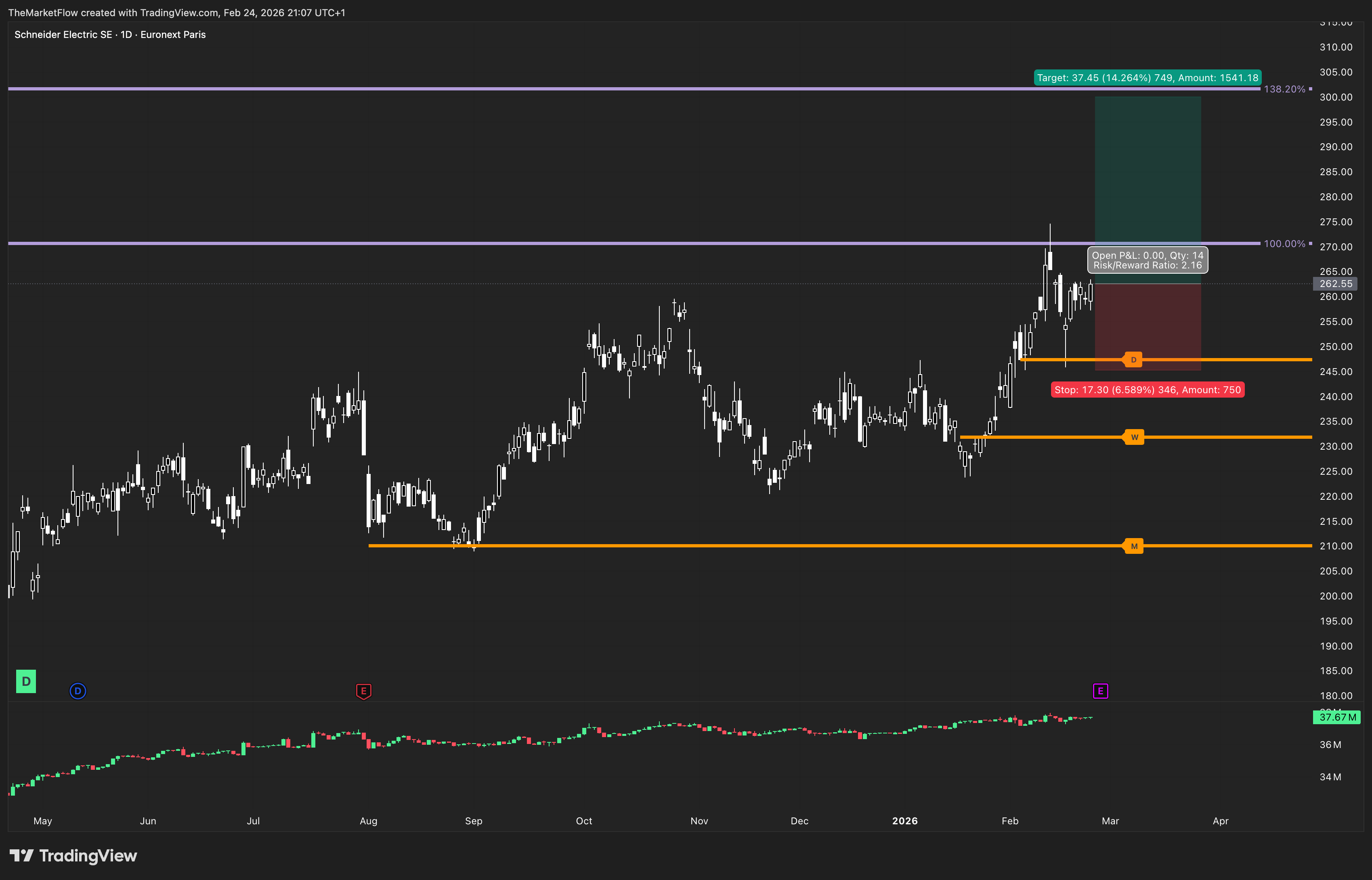
Schneider trades around €262 per share (Feb 20 2026) . Using FY 2024 EPS of €7.61 , the stock sits on a high P/E of ~34×, and the enterprise value is roughly 18× EBITDA. Those are rich multiples, but they reflect Schneider’s unique mix of hardware, software and sustainability leadership.
Target price: I believe the shares could reasonably reach €300 within the next 12–18 months—a roughly 14 % upside from current levels—if management delivers on its 2025 goal of 7–10 % revenue growth and 10–15 % adjusted EBITA growth . This target implies a forward P/E in the high‑20s, still demanding but justified by secular growth.
Stop‑loss: Given the high valuation, I would set a stop‑loss at €245 to limit downside. This level sits near the 2025 support area and equates to roughly a 7 % decline from today’s price. Investors should be comfortable with volatility and be prepared to cut losses if macro conditions deteriorate.
Key risks
Cyclical exposure. Industrial and construction markets are cyclical; Industrial Automation revenue fell in 2024 and free cash flow weakened in early 2025 . A global slowdown could weigh on earnings.
Currency and geopolitical risk. Schneider’s global footprint exposes it to foreign‑exchange swings and geopolitical turbulence. FX headwinds trimmed margins in H1 2025 .
Execution on software transition. Integrating and monetizing the AVEVA acquisition and transitioning customers to subscriptions pose execution risks .
High valuation. At ~34× earnings, the stock leaves little room for missteps. Investors must believe in the long‑term growth story.
Bottom line
Schneider Electric isn’t a cheap stock, but you rarely get bargains in companies that sit at the intersection of electrification, automation and sustainability. With record financials, improving margins and strong structural tailwinds, I’m comfortable with a bullish view. My stance: accumulate on dips with a price target of €300 and a stop‑loss at €245. This is a high‑quality name to own as the world powers up.
Disclosure: This post reflects personal views and is for informational purposes only. It is not investment advice. Consult a professional advisor before making investment decisions.